What to Check When Buying a Used Truck from China – Complete Inspection Guide
A used truck inspection guide from China has to check what actually fails on a 5–10-year-old heavy truck: cracked frame rails, tired dump hydraulics, worn kingpins and clocked odometers. This 30-point checklist, a 45-minute remote video protocol and real 2026 inspection costs show African importers exactly what to verify before they send a deposit.
Why a Used Truck Inspection Is Not a Car Check
On a heavy truck, a missed fault costs roughly 5–10 times what the same miss costs on a car, because frame and hydraulic repairs are straightened, welded and pressure-tested rather than simply unbolted and replaced.
Chinese heavy trucks reach an export yard after 300,000–600,000 km of haulage, quarry or construction duty. That workload leaves three signatures a car-style check ignores: frame flex cracks near the spring hangers, heat damage in the dump hydraulics, and driveline wear at the fifth wheel, kingpins and propeller shaft. Also, export yards repaint cab and chassis, so look for overspray, fresh seam sealer and mismatched paint shades instead of trusting gloss.
Two China-specific traps matter just as much. First, domestic-spec trucks often carry different tyres, lighting and emission hardware from the export-spec version your own market expects. Second, odometers on older HOWO and Shacman units are mechanical or easily reset, so condition means more than the number on the dashboard. However, you can cross-check mileage against tyre wear, pedal rubber and VIN-linked service records using our used truck VIN check guide.
The 30-Point Used Truck Inspection Guide
Work through these 30 checks in order and score every line as pass, monitor or reject. Because frame, hydraulic and VIN faults cannot be fixed economically before shipment, any failure in those three areas means you walk away from the truck.
Frame, Engine and Driveline Checks (Points 1–10)
Since everything behind the frame depends on a straight rail, start there and work forward through the driveline.
| # | Area | What to check | Reject if |
|---|---|---|---|
| 1 | Frame | Rails and crossmembers, especially near spring hangers | Cracks, weld repairs or a bent rail |
| 2 | Frame | Rivets and bolts at each suspension bracket | Loose or sheared rivets |
| 3 | Engine | Cold start and blowby from the oil filler | Heavy blue smoke or hard cold start |
| 4 | Engine | Oil colour, coolant colour, seepage points | Milky oil or continuous leaks |
| 5 | Turbo | Shaft play and oil residue in the intake | Whine or blue smoke under load |
| 6 | Gearbox | Shift quality through every gear, hot and cold | Jumps out of gear or grinds |
| 7 | Clutch | Pedal bite point and free play | Slips under load or bites at the floor |
| 8 | Driveline | Propeller shaft joints, centre bearing, diff noise | Vibration under load or diff whine |
| 9 | Fifth wheel | Jaw wear, locking and release | Jaw does not lock positively |
| 10 | Brakes | Drum or disc wear, air leaks with engine off | Pressure drops fast or metal-on-metal |
Steering, Suspension, Tyres and Dump Body (Points 11–20)
Then move to the running gear, because steering, tyres and suspension decide whether the truck is safe on your roads.
| # | Area | What to check | Reject if |
|---|---|---|---|
| 11 | Steering | Free play at the wheel, kingpin lift | More than 25 mm free play |
| 12 | Tyres | Brand match, tread depth, sidewall cracks | Mismatched sizes or exposed cords |
| 13 | Wheels | Rim cracks, rust streaks from bearings | Cracked rim or hot bearing marks |
| 14 | Suspension | Leaf springs, U-bolts, shock absorber leaks | Broken leaf or cracked spring hanger |
| 15 | Dump body | Floor and side plate thickness, crack repairs | Holed floor or weld-on patches |
| 16 | Hydraulics | Full raise and lower cycle, hold under load | Creep-down or weeping cylinder seals |
| 17 | PTO | Engagement noise and oil leaks | Grinding engagement |
| 18 | Cooling | Radiator fins, fan hub, hose softness | Blocked core or oil in the coolant |
| 19 | Exhaust | Manifold cracks, DPF and SCR condition | Broken manifold or deleted emission system |
| 20 | Fuel system | Injector return flow, tank contamination | Metal in the fuel filter |
Cab, Electrics and Paperwork (Points 21–30)
Also check paperwork with the same rigor as metal, because a VIN mismatch makes the truck unsellable in any market.
| # | Area | What to check | Reject if |
|---|---|---|---|
| 21 | Cab | A-pillar and floor rot, door alignment | Structural rust or twisted cab |
| 22 | Electrics | Lights, wipers, gauges, battery age | Dead circuits or bulkhead rewiring |
| 23 | Aircon | Cooling output on a hot day | No cooling and no compressor clutch |
| 24 | Repaint | Paint thickness on cab and body panels | Thick filler over panel joins |
| 25 | Odometer | Wear versus mileage on tyres and pedals | Clear evidence of clocking |
| 26 | Test drive | Load, or simulate load on a gradient | Overheating or power loss |
| 27 | Leaks | Park overnight and read the ground | Fresh engine, gearbox or hub oil |
| 28 | Documents | VIN on chassis, plate and papers all match | Any VIN mismatch |
| 29 | Documents | Registration, invoice, customs status | Missing registration or liens |
| 30 | Export spec | LHD or RHD, tyre size, lighting spec | Spec does not match your market |
How to Run a Remote Inspection in 45 Minutes
A structured 45-minute video call catches about 80% of fatal faults, but only when you control the sequence and insist on a live feed rather than a pre-recorded clip.
Split the call into five timed blocks. First, spend 0–5 minutes on a slow walkaround with the phone held low, looking at frame rails and tyre sidewalls. Then use minutes 5–15 for a cold start — the seller must not warm the engine beforehand — and watch the exhaust for the first 60 seconds. Next, drive for 10 minutes on a road with at least one gradient, and ask the driver to hold a steady throttle so you can hear turbo and driveline noise. After that, raise and lower the dump body twice in minutes 25–35, because the second cycle reveals creep-down. Finally, close with paperwork: VIN on the frame, VIN on the plate and VIN on the registration on camera in one continuous shot.
Also ask for the ambient temperature, since a hydraulic test at 5 °C means little on a 35 °C port. Still, no video means no deposit, and that single rule filters most of the suppliers described in our used truck scams review of ten red flags.
What an Inspection Costs in 2026
Budget between zero and about 600 US dollars per truck, and treat anything above that as a full pre-shipment survey rather than a routine check.
| Option | Who performs it | Typical cost per unit | What it covers |
|---|---|---|---|
| Video call with the exporter | You, guided by the seller | $0 | Walkaround, cold start, drive, hydraulics, VIN |
| Independent mechanical check | Local inspection engineer | $150–$400 | Engine, gearbox, chassis, brakes, fault codes |
| Paint and body thickness test | Body shop with a gauge | $60–$150 | Hidden filler and accident repair history |
| Third-party pre-shipment survey | SGS-type inspection company | $300–$600 | Full report, photo set, loading supervision |
| Pre-loading container check | Port agent in Tianjin or Shanghai | $150–$350 | Lashing, securing, seal and loading photos |
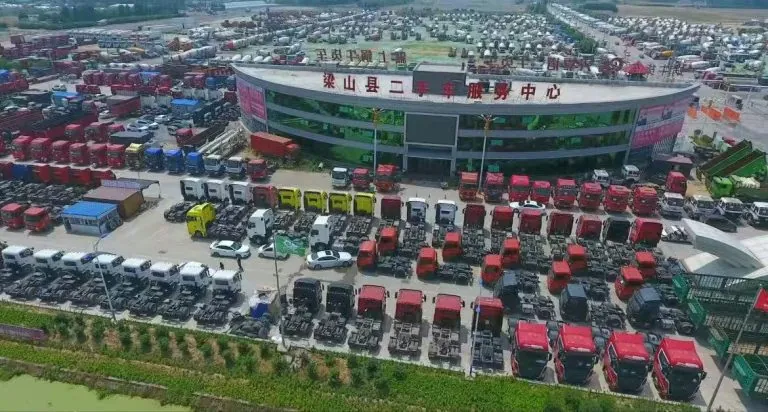
In our own yard in Shijiazhuang, the 30-point check above costs nothing, and customers receive the photo set and the cold-start video before they pay a deposit. For example, buyers comparing offers find that a video set plus a continuous VIN shot separates a real exporter from a broker with a phone, as set out in our guide on how to find a reliable used truck supplier in China.
Five Failures That Kill an Export Deal
Five faults account for most rejected trucks, and each one costs more to fix than the discount a buyer hoped to win. For example, a cracked frame rail costs 1,800–3,500 US dollars to plate, weld and re-certify, plus 7–14 days of yard time. Similarly, a failed hydraulic pump or dump cylinder runs 900–2,500 US dollars, and the part is rarely in stock for older models. Turbo and EGR damage adds 600–1,500 US dollars, usually alongside hidden oil consumption. Then there is kingpin, tie rod and steering box wear at 250–700 US dollars, which is a safety failure at port inspection. Finally, a clocked odometer carries no repair price at all, because the truck becomes unsellable once the buyer loses trust.
Frequently Asked Questions
Can I trust an exporter’s own inspection report?
Partly. Trust a report that includes a live cold-start video, a continuous VIN shot from chassis to registration, and photos of the faults you asked about. However, treat any PDF-only report with no video as marketing material.
How many kilometres is too many on a used HOWO?
Between 400,000 and 600,000 km is normal for a 6–8-year-old HOWO, and 300,000–450,000 km is typical for Shacman and FAW units of the same age. Judge the driveline and hydraulics first, because a well-maintained 500,000 km truck beats a clocked 200,000 km one. Meanwhile, our truck lifespan guide breaks down the expected rebuild intervals.
What is the most common hidden fault on used dump trucks?
Heat damage in the hydraulic system comes first, followed by cracked dump body floors. Both stay invisible in a stationary photo set, so ask for a full two-cycle raise and lower with a load, or at least a run to working temperature.
Do I need a third-party inspection for a $9,000 truck?
No. For a 9,000-dollar unit the freight and import duty already dominate the budget, and a 300–600 dollar survey is hard to justify. Instead, run the video protocol above and buy from a supplier who owns the truck. However, above roughly 25,000 dollars, a third-party survey pays for itself.
Quick Answer: Used Truck Inspection Guide from China
- First, run the 30 points in order and reject frame cracks, hydraulic creep-down, VIN mismatches and clocked odometers.
- Then insist on a live 45-minute call: walkaround, cold start, drive, two hydraulic cycles, then paperwork in one continuous shot.
- Also expect 0–600 US dollars for inspection, and treat our yard check as free with every unit.
- Next, match LHD or RHD, tyre size and lighting spec to your market before you pay, and check the age limits in our country age-limit guide.
- Finally, pay only against documents and shipping milestones, as set out in our LC and TT payment guide.
Ready to compare inspected stock? Then start with current tractor truck prices in Africa, or read the full import process from China and our cost breakdown for RoRo and container shipping.
🔗 Related Products
Related reading: a customs clearing vehicle in stock.
About the Author
Wang Jianbin is the founder of HebeiCar (hebeicar.com), a China-based used truck exporter. Since 2014, he has helped 500+ fleet owners and dealers across 20+ African countries — Nigeria, Ghana, Kenya, Tanzania, Zambia, DRC, Ethiopia and more — source quality used HOWO, Shacman, FAW and FOTON trucks at factory-direct prices. Every truck is inspected in his own yard in Shijiazhuang, Hebei before shipping, and he writes about import procedures, shipping logistics, customs clearance and truck selection based on that real export experience.
Watch real inventory walkaround videos on the YouTube channel, or contact Wang Jianbin directly for current inventory and CIF prices via WhatsApp.